Secrets To Accomplishing More During The Workday

Rachel Beider shares her wisdom this week in Forbes

Even for the most successful entrepreneurs, there are only so many hours in the day. But with all the duties, responsibilities and pressures that come with being a business owner, finding ways to improve and optimize their productivity is an important, necessary part of their day-to-day work. So how do they do it?

1. Working On What Only I Can Do

The first step is to define what you can do best, and then figure out what only you can do. From there, you should audit your days for a week or so to see how much time you are spending on tasks that are uniquely suited to you. Everything else should be assigned to others on your team. You need to constantly make sure you're not doing busy work or in-the-weeds work, as they can creep up over time. That way, you stay in touch with doing the highest-level work that moves the company forward. - Allison Esposito Medina, Bootstrap to Millions (with Allison)

2. Prioritizing Business Needs Over Client Needs

The one area women in particular seem to struggle with is prioritizing their business needs before those of their clients. Starting the day with your sales activities and prioritizing the success of your own business before your clients’ is key to leading yourself and others in their success. This means you can grow your own business and lead by example so your clients can do the same. This also means that your work becomes more intentional and your leadership more impactful as a result. This simply requires boundaries around schedules and strong communication with your team and clients. - Leanne Lopez Mosley, GROW Coaching Solutions

3. Clearly Defining My Values And Goals

As a working mom, I find that maximizing my days isn't just useful—it's vital. I'm all for the mantra of "work smarter, not harder." Too often nowadays, effort and exertion are confused with impact and results. It truly comes down to prioritization. What task or activity, if not done today, will be detrimental to your future success or the success of your organization? Cutting through digital clutter to identify your priority is imperative. Stop thinking reactively, and start playing by your own rules. If your values and goals are clearly defined, it will be that much easier to focus and organize your output based on what will drive the needle forward. - Ashley Sharp, Dwell with Dignity

4. Starting My Day With Self-Care

Each morning, I prioritize moving my body—even if it's just for 15 minutes—and then a minimum of five minutes each for meditating, reading and journaling. This half hour of dedication to myself sets the tone for my day to get the more meaningful things done. I'm a go-getter who is action-oriented, but sometimes I find myself focusing so much on my to-do list and answering my emails that I have to stop, reflect and ask myself what the top three things are that I want to get done that day. Then I ask myself what is the No. 1 thing that will reap the most results? By starting my day with self-care, I focus on things that matter, reap results and that I'm naturally good at. - Givelle Lamano, Lamano Law Office

5. Focusing On High-Level Tasks

A CEO only has a few core responsibilities: to define the long-term vision of the company, to hire the right executive leaders, to ensure that the company never runs out of money and to delegate absolutely everything else. I get the most done during my workday by focusing on these high-level tasks and empowering my team to take care of everything else. - Rachel Beider, PRESS Modern Massage

6. Writing A List Of Tasks By Importance

Prioritizing your work and tasks is a vital skill to learn as an entrepreneur. This can be done in a variety of ways, but one that I find effective is creating a handwritten list of tasks and writing them down in order of importance. This technique helps me stay focused on the tasks at hand without getting overwhelmed or scattered with other tasks. - Kristin Kimberly Marquet, Marquet Media, LLC

7. Staying Organized At All Times

My secret is that I stay organized at all times. When you have clarity with respect to your goals and what you need to do, you tend to perform better and get more done due to uninterrupted focus. An unorganized and cluttered to-do list hinders your productivity. You end up wasting your time and energy trying to figure out what needs to be done rather than doing it. This not only affects your quality of work, but it also leaves you with a dwindling focus for the rest of the day. As a result, you are less likely to keep up with your deliverables, let alone get more done during your workday. - Stephanie Wells, Formidable Forms

Rachel Beider in Forbes: How to Measure the Success of your Workday

When it comes to defining success, there’s no one right answer. It can mean owning your own business, making over a million dollars, driving a particular car or even just having more freedom with your time. But when broken down into a single workday, success can sometimes be a little more difficult to measure. Its definition can even change throughout your career as you develop both professionally and personally.

1. My To-Do List Is Shorter Than At The Beginning Of The Day

My days consist of to-do lists. At the end of my day, I look at my list, and if it’s smaller than what it was that morning, I deem it a productive day. As an entrepreneur, you can’t expect to check off everything on your list. But, if you feel like you’ve made some progress, big or small, this indicates that you’ve had a successful day. This mindset wasn’t always the case for me. I used to think that a successful day consisted of completing a large project or closing an important deal. Success is a series of small accomplishments. My best piece of advice is to create realistic to-do lists daily and try to check off at least three tasks before the end of the day. - Nick Venditti, StitchGolf

2. I Have Enough Energy To Enjoy My Time After Work

I know that my day was successful when I leave the workday with enough energy to enjoy my life outside of work. As I've moved through my career, I’ve learned to base my accomplishments on how I'd like to feel rather than on outside metrics of success. This means I tailor my daily activities and set goals based on how I want to feel. For example, if I want to feel more confident, I make sure to work out and blow-dry my hair. If I want to feel more connected, I schedule time to call my family and hang out with my friends. If I want to feel more successful, I make sure that my work is organized and that I have a lot of energy and passion to do it. I don't force myself to be "productive" on days that I'm not feeling it. - Rachel Beider, PRESS Modern Massage

3. I've Worked With My Team To Identify New Solutions And Opportunities

When I started my business, I associated success with sales wins and good news. Now, I associate a successful day with resilience. As an entrepreneur, you eventually realize that every day will bring challenges and new problems to solve. Success is when we work as a team to come up with new solutions and even identify new opportunities that will make our business that much stronger as a result. - Christina Drake, Willa's Oat Milks

MORE FOR YOU

They Inherited Billions Upon Billions: Meet America’s Richest Heirs

Education Is A Matter Of Life And Death In ‘The Queen’s Umbrella’

Anfield’s Famous Atmosphere Can Play A Part In Liverpool’s Turnaround

4. My Actions Today Have Made A Long-Term Impact

Early in a career, a good day may be determined by the ability to complete a project, close a deal or work through a task list. As my business progresses, I measure success based on the long-term impact of my actions today. This has helped me develop a more forward-looking approach in everything I do so that my time is better spent developing the company instead of just overinvesting time in the trenches. When you accomplish tasks that help drive the business forward for the coming months and years, you're able to sustainably grow your revenues and profits. - Firas Kittaneh, Amerisleep Mattress

5. I've Moved The Needle On Something

When I started my career, I judged the success of my day by my to-do list. If I finished it, the day was successful; if I didn’t, it wasn’t. But I realized that such a cut-and-dry indicator of success wasn’t realistic for me. I run a startup, so there are constantly things that pop up requiring my attention that I can’t always anticipate. I might put out 10 fires and, therefore, only do one thing on my to-do list. On paper, the day was unsuccessful, but in reality, it was productive in the places it needed to be at that given moment. I’ve since altered my definition of success and instead ask myself at the end of the day, “Have I moved the needle?” If the answer is “yes,” then I’ve had a successful day because I’m making progress, and on busy days, sometimes that’s all you can ask for. - Diana Goodwin, MarketBox

6. I Have Peace Of Mind At The End Of The Day

My peace of mind at the end of the day is a reasonable indicator. If I've accomplished several things I needed to, my mind lets me sleep well and move on. If I hit unavoidable delays all day or procrastinate, I'll be much more dissatisfied and wired by the end of the day. As for changes throughout my career, I think a younger version of me focused on the number of hours I worked. An all-nighter or marathon work session was like a badge of pride. Now I focus on meaningful work and deeper connections and relationships with my teammates. It's not the number of hours—it's how you spend them. - Tyler Bray, TK Trailer Parts

7. I've Stuck To My Daily Schedule

I always start the professional part of my day with a list of incremental tasks necessary to achieve big goals. I start with that list and then move ahead by ticking the boxes as I complete the tasks. These tasks are also multifaceted: Some of them are pure executions and some are regular business communications, team meetings and so on. I started this practice on the first day of my professional career. I continue it because I believe in simplicity. This practice brings me extreme satisfaction as it tells me that I'm moving in the right direction. To me, success is sticking to your daily schedule. Regularity brings sustainable growth, and this is what matters to me. It ensures that collectively we are moving toward achieving our professional goals. It gives me a sense of completeness. - Vikas Agrawal, Infobrandz

8. I Tackled My Biggest 'Rock'

It all depends on what success looks like to you. At the beginning of your career—and it's okay if you still do this—it might look like crossing items off a to-do list. It could also look like getting to inbox zero. If you get most or all of your task items completed, that might be the definition of a successful day for you. For me, it's tackling my biggest rock. At the beginning of each day, I jot down the three big "rocks," or actions, I need to complete. When I close my laptop at the end of the day, if one of those rocks has been moved, I consider the day a success. Over the years, this has become easier to manage and more of a focus. I used to think being busy was success, but now I know success is about making one significant impact time and time again. - Jared Weitz, United Capital Source Inc.

9. I Feel Happy With My Work

In my mind, I've had a successful day if I'm happy with my work. I think it's important that we are satisfied with the progress we've made. If you constantly compare yourself to other high-profile business owners or doubt your work, you will have a hard time growing personally and professionally. I suggest establishing a to-do list and managing it based on your standards and expectations. I'll admit, this is different from how I used to do things. I would look at successful people in my industry and strive to do what they do: work 13-hour days, six-day workweeks with little time for much else. I quickly discovered this lifestyle wasn't for me. I needed to find a way to fit that level of productivity into a seven-to-eight-hour block, so that's what I did. - John Brackett, Smash Balloon LLC

Rachel featured in Small Biz Trends: Signs it's time to Cut Ties with a Vendor

Maintaining good relationships with your vendors helps ensure that you consistently receive the goods and services you need and achieve mutually beneficial goals. But when the buyer-supplier relationship begins to sour for whatever reason, it may be best for your business to cut ties and move on.

To help you determine whether it’s time to seek out a new vendor partnership, 11 Young Entrepreneur Council (YEC) members shared their insights on the following question:

“What’s one warning sign that it might be time to cut ties with a particular vendor, and why?”

1. They Won’t Renegotiate Redlined Clauses

“Sometimes it’s hard to know which side people are on or if they will even change sides. If you redline a harmful clause in your contract and send it back to a vendor, they will react. There’s no problem if the reaction is a compromise. If it’s not, and things escalate, end the relationship. Compromise strengthens aligned relationships and breaks misalignment.” ~ Sean Adler, GZI

2. They Can’t Deliver Within an Expected Timeline

“Our saying is, ‘You are only as strong as your weakest partner.’ If our vendors can’t deliver consistent products or within the timelines our customers expect, we move on quickly. There is always another great vendor out there who wants to work as hard and as thoughtfully as we do.” ~ Michael Barnhill, Specialist ID

3. They Affect the Quality of Business Operations

“A big red flag is when vendors begin to affect the quality of your business operations and offerings. This might look like failure to deliver supplies on time, quality going down or failure to communicate. Of course, mistakes can happen. But if the situation becomes a pattern, it’s a sign to move on before their lack of discipline disrupts your business operations and dampens quality.” ~ Blair Thomas, eMerchantBroker

4. They Stop Providing Product Support

“If a vendor stops providing product support, then it may be a good time to cut ties. Customers want to have a reliable source of information when trying out a new product or service. Business clients are no different; if you are not given any communication or contact when solving a problem, then you may want to switch providers.” ~ Duran Inci, Optimum7

5. Issues Continue to Occur

“The most significant warning sign in vendor relationships is when you’ve already communicated a problem and the issue continues to occur. Likewise, it’s also a bad sign if the communication has drastically changed or stopped between you and the vendor — or even worse, the communication has turned hostile. If the issue persists, it may indicate they are not up to par with the demands of your business and you need to take your business elsewhere.” ~ Jared Weitz, United Capital Source Inc.

6. They’re Causing the Bulk of Your Problems

“The Pareto principle states that roughly 80% of the outcomes come from 20% of the sources. If you notice that 80% of your problems are coming from one particular vendor, it’s time to cut ties.” ~ Rachel Beider, PRESS Modern Massage

7. They Aren’t Communicating Important Information

“The biggest red flag is when vendors aren’t forthcoming about delays, price changes, quality issues and more. They may disregard requests for information and operate outside of professional norms. In these instances, it’s obvious that the vendor is working in their best interests and not yours.” ~ Firas Kittaneh, Amerisleep Mattress

8. The Vendor Is Supplying Subpar Products

“If the product or service the vendor supplies is subpar and causing harm to your reputation, you should seek an alternative. Maintaining your standards is important, even if customers don’t notice right away. Eventually, it will catch up to you, so it’s not worth it even if it saves you a little in the short term.” ~ Kalin Kassabov, ProTexting


9. You Can’t Rely on Them

“Your business has so many aspects that demand your attention that you must insist on reliability in the people you work with. This is a reasonable standard, but remember, your vendor’s reliability has a direct impact on your own reliability. Nobody is perfect, but if you see some consistent failures of reliability, it’s time to start shopping around.” ~ Tyler Bray, TK Trailer Parts

10. They Have High Customer Turnover

“If a vendor has high customer turnover, I’d probably stay away from them. I wouldn’t make the decision right away, but the scenario would definitely raise a flag for me. I’d explore the reasons why people are leaving that particular vendor. For that, I may get in touch with a few of those people and find out.” ~ Stephanie Wells, Formidable Forms


11. They Start Acting Like Your Competitor

“One of the biggest red flags with any vendor is if they start trying to compete with you directly. This means they don’t respect the relationship and are more interested in their own bottom line. It can also lead to tension and conflict later on. If a vendor starts acting like they’re your competitor, it’s time to reevaluate the relationship.” ~ Sujay Pawar, CartFlows

For more on this article in SmallBizTrends click here

Rachel Beider's Latest Advice on Leadership in Forbes

Seven Limiting Beliefs That Can Hold Female Entrepreneurs Back

Despite female entrepreneurship trending upward—especially in recent years—on a global scale, male entrepreneurs still outnumber their female counterparts three to one. Statistics like this one, paired with feelings of doubt and a sense of imposter syndrome any aspiring entrepreneur is sure to feel when starting out, can often leave young female entrepreneurs with one or more limiting beliefs that can hold them back from accomplishing everything they’re capable of.

1. I Need To Come Across Like Male Entrepreneurs Do

One limiting belief is that women need to come across as brash and confident as the male entrepreneurs we see in the media, even if that doesn't feel authentic to us or work for us. When pitching investors, you do need to be confident. At the same time, confidence can and should come from a place of authenticity and passion for what you're doing. - Christina Drake, Willa's Oat Milks

2. My Business Must Be Perfect Before I'm A True Entrepreneur

A common limiting belief among female entrepreneurs is that they don’t deserve a seat at the table until their idea is 100% perfect, launched and revenue-generating—which isn't true! Ultimately, it’s all about confidence. If you don’t have complete confidence in yourself yet, but you know your business idea is sound, then just get started. That self-confidence will come with time. - Diana Goodwin, MarketBox

3. Having A Family Will Limit My Success In Business

There's a common notion that having a family as a woman is a barrier to pursuing executive roles and running successful business ventures. Practical experiences show that circumstances do not dictate how far you go in life. There are countless examples of women who have broken glass ceilings while managing a family and a successful business. If anything, they become more driven and relentless in their pursuit. - Tonika Bruce, Lead Nicely, Inc.

4. Being A Solopreneur Is Better Than Having A Partner

I think the one limiting belief a lot of young female entrepreneurs have is the unwillingness to partner with others even if the affiliation shows promise. Most female entrepreneurs want to be sole proprietors. But, partnerships are often essential for growth. So, it's better that you start entertaining prolific future partnership proposals. - Stephanie Wells, Formidable Forms

5. If I Fail, Then I Am A Failure

The fear of failing holds more people back than the actual pain of failing. Learn the lessons from the failure, move on and try again. Accept that it will happen. When it does, be prepared to analyze what worked and what didn't. From there, you can adjust, change and try again. These small adjustments will be what allows you to succeed. - Mary Harcourt, CosmoGlo

6. I Can't Charge What I'm Worth

A common limiting belief that I see in young female entrepreneurs is that they have to undercharge. They haven't yet learned to value their time properly and often get underpaid because they don't ask for enough from their clients. To properly value your time and services, it's important to research the market, discern what others are charging and price yourself accordingly. - Rachel Beider, PRESS Modern Massage

7. I Have To Work Twice As Hard Because I Am A Woman

The most limiting belief female entrepreneurs have that I’ve experienced is that they have an inherent sense of being “a woman” and always try to overcompensate for that. Going the extra mile to achieve something is not always harmful. But, doing this for being a female entrepreneur is something else. The cardinal reason behind this may be that this ecosystem is still governed by men. - Candice Georgiadis, Digital Day

For more on this post, see Forbes here

"Create An In-Store Experience That Will Surprise And Delight" - Rachel Beider for Forbes

In an age when more and more businesses are moving to or being created online, one advantage brick-and-mortars have over online stores is their ability to create in-person experiences and atmospheres that can surprise and delight their customers. Experiences rife with human connection and sensory enjoyment simply aren’t able to be duplicated in the online space in the same way.

1. Create A Branded Social Media Moment

Make your store memorable by creating an easy social media "moment." Adding a branded wall, a cool sign or a nice "Selfie Station" in your store is an easy way to boost in-store customer engagement while getting free online promotion for your space. In my massage therapy clinic, we have a lot of beautiful spaces that clients often take selfies in front of. I've seen a lot of brick-and-mortar businesses do this well with neon signs, plant walls, murals and interesting art. Make sure to include a branded spot on the wall so clients remember to tag your business in their posts. - Rachel Beider, PRESS Modern Massage

2. Offer Samples Of Your Products

Who doesn't love to sample? There's a reason why big-box retailers like Sam's Club leverage sampling as a primary way to drive sales; it's a great way to increase impulse buying and the law of reciprocity (you did something for me so I'll do something for you) and launch new or cool food products. If you aren't in the food business, don't fret. Leverage live models or product hosts to show off your products (think HSN and QVC). Imagine someone walking into your store to be greeted by a professional model showing off a new line of clothing. You can also hire a product host to set up live demonstrations. This will not only engage your customers and entertain them, but it will also encourage repeat customers. Trust me—my kids tell me every Sunday, "Hey Daddy, let's go to Sam's Club for samples." - Kristopher Brian Jones, LSEO.com

3. Provide Stellar Customer Service

One advantage that brick-and-mortar stores have over online stores is the ability to provide quick customer service. In-person experiences allow store employees to quickly resolve customer issues and address concerns. This can create a feeling of surprise and delight for customers who may not expect such quick and attentive service. To take advantage of this, brick-and-mortar business leaders should ensure that their employees are trained to provide quick and efficient customer service. Additionally, they should make sure that there are adequate staff levels during peak periods so that customer needs can be met in a timely manner. By providing excellent customer service, brick-and-mortar businesses can create an atmosphere of surprise and delight for their customers. - Pratik Chaskar, Spectra

4. Personalize Human Interaction

There’s power in personalization. Remember the customer's name, how many kids they have and what sports they play. A customer entering a brick-and-mortar store with someone saying “Hey John! It's great to see you. How is Millie's softball season going?” will outperform an online transaction any day of the week. In a screen-to-screen world, we often miss out on the personalized touch of human interaction. Brick-and-mortars have a chance to outperform any other sales channel by paying attention to their customers. If someone knows there is a warm hello and a handshake, they will more often than not choose the brick-and-mortar location over an online store. - Mary Harcourt, CosmoGlo

5. Incorporate An Augmented Reality Experience

Augmented reality can help create astounding in-person experiences and environments that lead to customer delight. It helps you get the traction that your store needs by helping you reinvent in-store experiences. Retail is changing, with more consumers preferring online shopping with every passing day. Augmented reality helps evolve a mainstream brick-and-mortar store and transform it into the store of the future powered by gamification and interactive experience for the customers. - Stephanie Wells, Formidable Forms

6. Offer Exclusive Products And Services

One way to create a unique and memorable experience for customers is to offer exclusive products or services that can only be found in your store. These could be anything from a limited edition item to a service that is only available at your location. By offering something unique, you can surprise and delight your customers, which will keep them coming back for more. To do this, you need to have a clear idea of what's available in the market and what your customers are looking for. You also need to be willing to experiment and take risks. By offering something unique, you may find that you have a real winner on your hands. - Syed Balkhi, WPBeginner

7. Appeal To The Five Senses

A simple way to enhance customer experiences is by appealing to the five senses. How does the brick-and-mortar location smell when people step inside? What do they hear? What can they touch? What do they see? If applicable, what can they taste? Try to cover all five of the senses to create an immersive brand experience that customers can’t find anywhere else. Did you know that Disney pumps specific fragrances into its theme parks to pique the sense of smell? Disney also plays different music depending on where guests are in its parks, and decorations change as well. Your brick-and-mortar location should communicate the essence of your brand through decor, music, scents and so on. Be unique and immersive so people can “live” your brand experience when they step through the doors. - Jonathan Prichard, MattressInsider.com

8. Build A Rapport

One of the best ways to create an in-person experience that will surprise and delight your customers is to build a rapport with them from the beginning. This can be done by asking good questions that show you are interested in who they are and what they need. For example, you could ask them about their day, their favorite products or what brought them into the store. By taking the time to get to know your customers, you will be able to create a more personalized experience that will leave them feeling positive about their interactions with your business. - Adam Preiser, WPCrafter

Original Article HERE in Forbes

Rachel Beider in Forbes: Tips For Achieving A Creative Flow State

Innovation is often a key driver for long-term business success, but in order to properly innovate, you have to get creative first. A creative flow state, or any length or period of time during which a professional can think and create uninterrupted by distractions or intrusive thoughts, can be beneficial to those aiming to generate quality ideas in less time—but getting into this state isn’t always the most straightforward task.

1. Clean Up Your Environment

I think that it is crucial to put yourself in an environment where you feel most inspired and creative. If your home office is messy, try this: Take an hour to clean up everything that doesn't belong where it currently sits. Move stuff around until things feel comfortable. That may mean getting rid of some things altogether or making more space for others in order to create an environment conducive to creativity and flow-state-inducing happiness. When I do this, or just tidy up a bit, I always feel better afterward—and I sometimes even notice myself getting into a flow state sooner than usual because I'm not distracted by messes or clutter! - Rachel Beider, PRESS Modern Massage

2. Step Away From Screens

I find that creativity blooms most when you’re away from a screen, so put your phone away and close your laptop. Spend time with family and friends, go on a walk or hit the gym and you'll find that using your brain for things outside of work actually helps you be more creative during work. Some of my biggest ideas and most clarifying moments have come while spending time outside. For me, experiencing the peacefulness of nature and being away from the office really gets the ideas flowing. - Leila Lewis, Be Inspired PR

3. Reduce Restrictive Thinking

Creativity is a skill that can be learned and practiced. It is not the result of a magical power but instead of a disciplined mind. It may sound trite, but to truly get creative, you must open up to creative impulses. Try to eliminate as many restrictions on your thinking as possible. I've learned over the years that a great way to get into a creative flow state is to listen to music that inspires me. I've found that listening to my favorite bands or composers is a great way to brainstorm ideas, write or draw. Also, take long, deep breaths. As you exhale, empty your mind and focus on your breathing. It usually doesn't take more than 10 minutes for me to start feeling the flow state kick in. Once that happens, I can crank out ideas with lightning speed. - Kelly Richardson, Infobrandz

4. Get Moving

My creative juices tend to flow when my body is in movement, such as when I'm out for a run, swimming or even in the shower. In my shower, I have something called AquaNotes, which suggests you "don't let great ideas go down the drain." My most creative state rarely happens when I'm at my desk. In my dance class, no phones are allowed in the studio, so when a bright idea comes in and I can't afford to lose it, I'll step out to go to the locker room and add a note to my phone. To get creative, get your body moving, listen to music and get away from your desk. - Givelle Lamano, Lamano Law Office

5. Declutter Your Mind

Companies are now investing heavily in their employees' mental health due to the sheer pressure of the workplace. Any creative flow starts with a healthy state of mind; you have to find a way to declutter it. Most creative people do daily meditation and deep mind detoxification to get into a creative flow state. Additionally, many creators and artists practice heavy meditation techniques to get completely engaged in their creative performance without a sense of time. They also protect themselves from distractions to continue their creative flow state and perform their daily tasks at high levels of dexterity without getting influenced by their ego and sentimental judgment. Always remember that creativity is your core feeling toward a particular challenge. - Candice Georgiadis, Digital Day

6. Clear The Noise

There are different ways to tap into your creative zone. Which one is best suited for you is defined by your personality, interests and preferences. For me, it's being close to nature, away from the hustle and bustle of the city. This clears the noise for me and helps fuel my creativity. The key is maintaining a constant focus and an uninterrupted state of concentration. So, what works for me may not work for you or anyone else. All you have to do is find what helps you gain focus—though I believe seclusion is the prerequisite. It's less likely for you to maintain a creative thought process when there's a lot of noise or people around you. - Stephanie Wells, Formidable Forms

Original Article HERE in Forbes

Honored to be profiled in NASDAQ!! Wow: "How Rachel Beider Is Transforming the Wellness Space Using a Clinical Approach"

This article was originally posted in NASDAQ

“Rachel Beider, CEO of PRESS Modern Massage, is dedicated to creating spaces for helping and healing through the power of clinical massage.

Rachel grew up with scoliosis and regular back pain and ultimately found relief from massage therapy. This ignited her lifetime goal of making a difference in the wellness field. With PRESS Modern Massage, she is able to deliver quality services to clients who experience all kinds of injuries from everyday life. And she’s making clinical massage therapy accessible to everyone.

We asked Rachel about the unique approach of PRESS Modern Massage, the importance of service leadership for company growth, and how she called on her resiliency in times of turbulence. 

Q: Tell us the story behind PRESS Modern Massage’s founding: How and why did you start working on your company?

A: I truly believe that “your mess is your message.” I grew up experiencing pain and discomfort from scoliosis, a curvature in the spine. I found that massage therapy was one of the few things that truly helped me to find relief, and it sparked a lifetime interest in wellness. I’m also a very multi-passionate entrepreneur, and in starting my massage therapy company, I got to experience the joys—and sometimes difficulties—of problem solving on so many different creative fronts. I love everything about owning a business!

Q: What are some of the most meaningful impacts PRESS Modern Massage has had so far? 

A: The joys of business ownership mean freedom to me on so many different levels of my life –– freedom financially, freedom to have the kinds of work relationships that I desire, and freedom to give back in ways that feel meaningful and impactful. My business has allowed me to hire and work with a phenomenal team and employ more than 50 amazing and talented people. We’ve treated over 40,000 people and helped them feel so much better. There’s something really special about getting to be the best part of someone’s day!

Q: What makes PRESS Modern Massage different from others?

A: We take a very clinical approach to our massage work, which is deeply rooted in anatomy and physiology. While the sessions we give are of a therapeutic nature, we did away with the cold, clinical feeling of paper sheets and bright lights, and instead have chosen a warm and relaxing setting. I find that the combination of medical massage in a warm cozy space is the most effective at treating both the physical and physiological effects of stress.

Q: In what ways has your upbringing or past experiences contributed to how you operate as an entrepreneur?

A: In working for others, I often felt like a bystander in my own career. I longed to be impactful—for my presence and work to feel important. I dislike the authoritarian approach of leading from the top down. Instead, I see myself as a “servant leader” in my company. My most important job is making sure that my team has everything they need to succeed, feel amazing, and thrive in their positions. I’ve found that this approach to leadership has led to higher employee retention, greater company culture, and overall happiness at work.

Q: What’s one thing you wish you had known before starting your company?

A: Learning to delegate efficiently was a real game changer for me. Inspired by Ari Meisel, my personal goal is to delegate 70 percent of whatever is on my plate each year to the next team member, and for them to do the same, all the way down the line. At the bottom, we automate everything possible. This way we keep moving forward with new opportunities.

Q: What are the biggest mistakes you’ve made?

A: The biggest mistake that I made as I was growing and scaling was not asking for help sooner. Learning to express my needs and be vulnerable was a real challenge for me. There was a time when I felt I was spread way too thin and like I was failing constantly. That burnout could have been prevented if I had brought on help sooner. 

Q: We dare you to brag. What achievements are you most proud of?

A: The achievement I’m most proud of is our team not giving up during the pandemic. New York State mandated our business closure for months, and there were several times that I came close to giving into the despair and fear of uncertainty. I gave birth to my first child about a week into the shelter in place order in New York City. Between the business closure and having a newborn, I was under an intense amount of pressure. During the closures, my company took a huge hit and we lost half of our locations. I tried to call on my own resilience and resourcefulness, and remind myself that if I lost great real estate, it’s likely that others did too. I knew that if I hung in there, I might be able to find some amazing locations on the other side of things. I can’t tell you how right I was! While we lost two studios, I’ve been able to open up two new studios in Manhattan, and in areas that were previously too expensive for us. We came out even stronger!

Q: What would you tell your younger self if you were to start your entrepreneurial journey all over again?

A: If I could go back in time and advise my younger self, I would tell myself that there will be so many ups and downs on this journey, and to trust my own resilience and resourcefulness. When things get difficult, instead of asking, “Why is this happening to me?” ask, “Why is this happening FOR me?”

Q: What’s next for you and PRESS Modern Massage?

A: We recently opened our Union Square location, which is already thriving. We just signed a lease on our beautiful Columbus Circle location, which will open in early 2022. And last but not least, we are hiring!”

Rachel Beider in Business Insider: 5 women who founded 7-figure businesses share their top strategies for success

Making the jump from a six-figure business to a seven-figure business is no small feat. As strategic marketing and brand consultant Hannah Nieves puts it, "What gets your brand to six figures is not exactly what gets you to seven figures."

So how does one level-up to reach that seven-figure mark? To gain some insight, we tapped into the experiences of five women from the Dreamers & Doers collective to learn more about the strategies that scaled their businesses past $1 million in annual revenue. Though each of the strategies featured below are unique, there is a common thread — the willingness to go against the grain, to try something new, to fail forward, and never settle. 

If growing to a seven-figure business is on your vision board, take it from the following women that it is possible with the right strategies in place.

'Be obsessed with data and finding the right traffic sources'

Hannah Kowalski, cofounder of Konscious Keto, combining AI technology, advanced supplements, and personalized coaching all in one platform

My No. 1 strategy for growing a seven-figure business: We were able to go from six figures to seven figures within a few months by utilizing very high-converting sales funnels on the right traffic sources. The key was continuous testing and optimizing and being obsessed with data. 

My advice: Find the top three traffic sources that you think would work best for your business. A lot of people just start with Facebook, but for some influencers and bloggers, maybe YouTube is a better fit. Look at your competitors and see where they're running their ads. Start with a small budget, and optimize for click-through rate and cost per thousand impressions first. Then move to the optimization phase, and eventually the scaling phase. Always be testing. Google Optimize is an awesome testing platform that you can use for free to do A/B testing and multivariate testing. 

'Delegate often and efficiently'

Rachel Beider

Rachel Beider, CEO of PRESS Modern Massage, an award-winning modern massage company with locations in NYC

My No. 1 strategy for growing a seven-figure business: When I opened the second location of my massage therapy business, I felt stretched too thin, and like I was failing all of the time trying to do everything myself. I had to get out of my own way and learn to ask for help. Being able to delegate effectively made a massive difference in the growth of my company from six to seven figures.

My advice: Every year, aim to take 70% of whatever you're doing off your plate and delegate it down the line to the next person. Your team should always be learning new skills, growing, and being open to even more opportunities. Approach these changes from a place of servant leadership, making sure that your team has everything they need to thrive and succeed.

'Make mistakes quickly and find improvements accordingly'

Victoria Repa, founder and CEO of BetterMe, a leading behavioral healthcare company

My No. 1 strategy for growing a seven-figure business: The key to my success is the "fail fast and cheap" strategy. The idea is that you should experiment and move quickly, and find mistakes and possible improvements before you invest more in the product. We learn the most from our failures, but expensive mistakes can tank any business. 

My advice: Some of your opinions about the market, customers, and their behaviors are probably just assumptions. Be sure to test your ideas as fast as you can, make a decision, and implement them. Then wait, analyze, and repeat the cycle.

'Ensure your customers feel valued'

Jolene Delisle, founder at The Working Assembly, a branding and creative agency partnering with emerging and evolving brands

My No. 1 strategy for growing a seven-figure business: The strategy that enabled me to go from a six-figure business to seven-figure was actually taking on projects and clients for less money. I know this sounds counterintuitive, but every time someone gives you money — whatever the amount — it's very important to be as accountable as you can be with that trust. In doing so, we grew our organic referrals because clients felt valued and reassured. 

My advice: Invest in yourself — believe that you can do it, and you are worth the risk. 

'Shift your mentality to operating a seven-figure business'

Hannah Nieves, founder of Hannah Nieves Consulting, a strategic creative consulting agency that champions luxury lifestyle visionaries

My No. 1 strategy for growing a seven-figure business: My strategy actually didn't have anything to do with business — it had to do with mindset. My business was growing quicker than where I was mentally, and I had to shift the perspective that we were operating a business of that size in such a short amount of time. 

My advice: I would recommend getting very clear on your future vision of the brand. As you're scaling your company, it can be easy to get stuck in the day-to-day and lose sight of where the brand is going to be five to 10 years from now. 

My latest advice in Forbes: 10 Essential Leadership Skills Every Entrepreneur Should Continually Hone

YEC Expert Panel

1. Listening To Understand

Listening is one skill you should continue to nurture over the years. The more successful you become, the easier it is to simply take your opinion while accepting it as the end all be all. Having humility and remembering to hear out another person will keep your business from plateauing or crashing. When you listen to someone else, you get their perspective on a situation. What's more, you may learn something that you haven't considered before. For example, a marketer may know about a new potential technology that could adjust to changes in Google algorithm updates. That information is crucial for marketing agencies, so they can adjust their services. - Duran Inci, Optimum7

2. Emotional Intelligence

Communications and emotional intelligence are always high on my list for continual improvement. Though leaders may grow more comfortable with their communications style (and their team may also grow more comfortable or accommodating) this doesn't actually mean you're improving. Entrepreneurs and other leaders, regardless of organizational affiliation, should continually evaluate their communications style, delivery, verbal/nonverbal mix, emotional intelligence, ability to coach and other important aspects of working within a team. - Christopher Tarantino, Epicenter Innovation

3. Ability To Delegate

Every year, a strong leader should take 70% of their work tasks completely off their plate, and pass them on to the next in command (this continues down the entire chain). Delegation is a skill that entrepreneurs must continually develop. Successful delegation ensures that we avoid decision fatigue and burnout and that we are constantly learning new skills and moving the company forward. - Rachel Beider, PRESS Modern Massage

4. Strategic Thinking

In my view, one skill that you must continue to work on is strategic thinking and acting. According to Harvard Business Review, today's businesses must be fluid and quick to change, which is why strategic thinkers are among the most effective CEOs. In the report, HBR discovered that a strategic approach to leadership was 10 times more significant than other behaviors tested, such as communication and hands-on tactical behaviors, in terms of perceived effectiveness. Strategic thinkers approach problem-solving and decision-making from a broad, long-term perspective that includes objective analysis, foresight and planning. Leaders must consider the best path to achieving outcomes that exceed the expectations of those they serve. - Baruch Labunski, Rank Secure

5. Communication

Communication is a skill every leader should continue to work on. No two people communicate the same way, and with how many people business leaders and CEOs engage with—employees, investors, clients, partners, publicists, audiences, contractors, etc - having a wide arsenal of communication styles is key. A good communicator should be able to adapt their style to whoever they're speaking with, be able to communicate their message clearly and in as direct of a way as possible and know when to keep it formal and when it's appropriate to be more casual. An effective communicator takes their cues from the other party, so improving and sharpening this skill is something that can only happen over time as you engage with a larger variety of people - Leila Lewis, Be Inspired PR

Skip in 5s

6. Financial Knowledge

It’s crucial for any business owner to have advanced knowledge about financials, especially the ability to forecast. Forecasting involves using past data to predict future success, sales and trends. It’s so important because it's the driving force behind most company's decisions and trajectories. The ability to forecast also allows a company to create built-in processes to manage unpredictability and unforeseen events. The key to successful forecasting is to create methodologies that ensure data is directional and credible. The methodology should also include both quantitative and qualitative factors. I would suggest even creating a strategic foresight team for an even greater chance of success for the entrepreneur and the business - Shu Saito, All Filters

7. First-Principle Mindset

One of the key skills any high-performing leader should implement is developing a first-principle mindset that frames learning in a more structured way. Beginning by learning the most pertinent first principles enables even the most abstract of concepts to be understood. For example, learning the key laws of physics that govern rocket propulsion when you want to understand how to design a more efficient rocket that can travel further with less fuel for higher payloads. Without knowing the first principles, that problem seems insurmountable to those unversed in physics. But there are really only a few physics principles that are pertinent to the rocket problem, not the entirety of physics, so it really comes down to learning those few principles, a much more digestible task. - Richard Fong, ProcessingCard.com

8. Building Trust

Leaders should never stop trying to build trust with their employees no matter what. For a business to run smoothly, it's crucial to have a cohesive team that works together and trusts you to make the best decisions in their favor. Too many business owners make the mistake of not making trust-building a priority, and this causes miscommunications across the board. You also want your team members to trust you enough to come to you with any issues they're facing to foster a positive company culture. - Stephanie Wells, Formidable Forms

9. Self-Awareness 

It's important to know your weaknesses. It's critical as a leader to decide the areas that you're going to build yourself or support through the recruitment of in-house experts. At some point, enhancing your skillset makes sense, while other times, it's more time and cost-effective to lean on the expertise of other people. It's essential to continue developing and making calculated bets on where your time and energy will make the largest impact. Doing this will allow you to gain experience in areas that you may formerly lack while also being honest with when it's time to utilize the skills of others. Over time, you will end up having more and more strengths through continued learning, whether that's by learning the skill or delegating. - Tyler Quiel, Giggster

10. Self-Development

It’s a bit cliché, but business owners should always work on themselves. Your relationship with yourself is something you can always learn something new from, so it’s important to stay well aware of how you’re growing, adapting, and evolving. Being critical of yourself and self-aware is crucial to your decision-making process, especially in business. It shapes your perception of what’s important which can either hinder or prosper your personal and professional life, and in turn your business. Partaking in activities to improve and/or challenge yourself, like meditation, or even discovering new hobbies and interests along the way, is a skill that helps you be at your best. - Emily Stallings, Casely, Inc.

Original Article posted in Forbes

Rachel Beider Honored in Forbes Next 1000 List

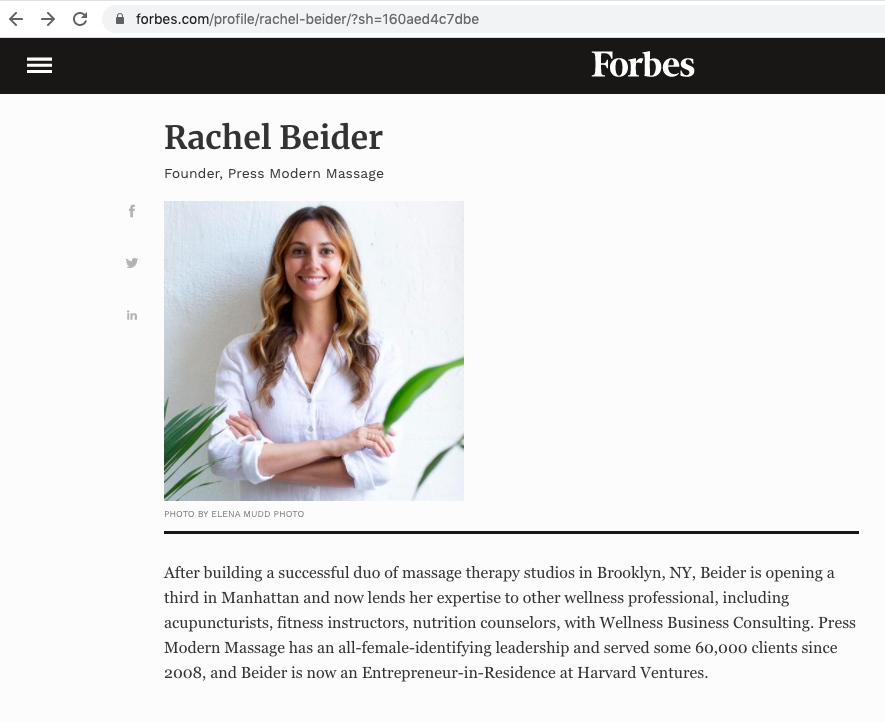
Thrilled to announce Rachel Beider in “The Forbes Next 1000 List: The Upstart Entrepreneurs Redefining the American Dream”

Screen Shot 2021-06-21 at 3.12.14 PM.png

“After building a successful duo of massage therapy studios in Brooklyn, NY, Beider is opening a third in Manhattan and now lends her expertise to other wellness professional, including acupuncturists, fitness instructors, nutrition counselors, with Wellness Business Consulting. Press Modern Massage has an all-female-identifying leadership and served some 60,000 clients since 2008, and Beider is now an Entrepreneur-in-Residence at Harvard Ventures.”

Screen Shot 2021-06-21 at 3.13.17 PM.png